Showing posts with label security professionals. Show all posts

Friday, June 24, 2011

I admit, I laughed: LulzSec as popular as orgasms?

Unless you've been ignoring the news for the past few weeks, you've probably seen mention of LulzSec, and if you're a security person you've probably seen this article about Why [security folk] secretly love LulzSec. The short version is that they're the latest hacker gang, and rather than profit or social justice, they're just in it for the lulz. They're really making the state of computer security more obvious to the layperson:

LulzSec is running around pummelling some of the world's most powerful organisations into the ground... for laughs! For lulz! For shits and giggles! Surely that tells you what you need to know about computer security: there isn't any.

While I often joke that web security is an oxymoron, they demonstrate it in the funniest ways they can find. As a web security researcher, I have to admit that their antics often make me laugh... and kinda make me wish I was allowed to use stolen data for research -- all those passwords! Data was always hard to come by when I did my spam immune system work so that much just makes me salivate a little, even if I'm pretty sure our ethics committee wouldn't let me touch it. And it's not like I do authentication research. But still! Data! I hope someone's doing cool things with it.

But here's a bit of meta-lulz: LulzSec scam discovered on Facebook - but it's not what you think. The excellent Graham Cluley discovers a Facebook scam that purports to have a picture of a LulzSec suspect, and then he sleuths out that the pixelated bait picture is, in fact, of another hacker arrested in 2008.

This means that LulzSec is apparently now so newsworthy that potential pictures of them can be used as bait for Facebook scams. They're up there with Obama, celebrity sex tapes and the ever-popular dislike button.

I don't know about you, but I got a great chuckle out of the thought that LulzSec might be as popular as orgasms... at least when it comes to scam bait.

And to end with more lulz, here's my favourite LulzSec tweet of today, which came in the midst of explaining what they had and hadn't actually hacked as the media attributes everything and anything to them:
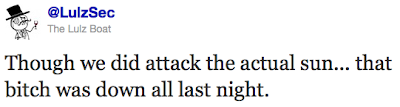
@LulzSec: Though we did attack the actual sun... that bitch was down all last night.

Wednesday, January 26, 2011

Ethical hacking? How about some ethical writing?


Now, I haven't verified this at all, but here's an interesting link for you: Ankit Fadia / Manu Zacharia - "Network Intrusion Alert" Heavily Plagiarized.

An extremely detailed analysis has been performed for the first chapter (10 pages) to show the scope and method of plagiarism. Our analysis shows that roughly 90% of the first chapter, including the six graphics used, has been taken from other sources. Due to time constraints, notes are used for brevity for the rest of the material.

Given my experiences with plagiarism among my undergraduate students and the recent Cooks Source plagarism story (which attracted quite a lot of attention)... I'm sadly inclined to believe that this entire book may be plagiarized.

What's funny about this story is that the book in contention here is titled "Network Intrusion Alert: An Ethical Hacking Guide to Intrusion Detection." Emphasis mine.

Friday, July 9, 2010

Preparing some curricula on web security

Among the other cool things I'm doing this summer is working as a teaching assistant for 1.5 days worth of tutorials on the subject of web security. This is part of my national research group's "summer school" program where we try to give our graduate students more background into other areas of security. I'm working up a list of potential topics so we can get our teaching materials together.

So... What would you want to learn in a short course on web security? What do you wish other people knew about web security?

Here's my brainstorming list, to be updated as new things occur to me:

Attacks

Defenses

  • Best coding practices
  • Web Application Firewalls
  • Web Vulnerability Scanners
  • Tainting
  • Mashup solutions (e.g. MashupOS, OMash)
  • Policies (e.g. SOMA, BEEP, CSP)
  • Penetration testing techniques

Notes: The tentative plan is to separate things into a hands-on lab tutorial (probably using webgoat) and a set of lectures, mostly running simultaneously. We're going to have some top-notch students here, since we're drawing from a pool of smart security researchers to start, so we can cover a lot of ground and go much further in depth than we might teaching developers with no security background.

Tuesday, July 29, 2008

What does security mean for web 2.0?

Clearly there is no widely accepted view of what security means in the Web 2.0 software development era. We’re still trying to figure things out and convince ourselves that we have the right answer. Or that someone does.

This is taken from a survey of web application security professionals. It's not a terribly scientific survey by any means, but I think it's interesting reading despite vague questions and a somewhat undefined audience.

The above quote really sums up what I got out of the article: that no one's really sure what web security means. The addendum to that is that people seem to feel that more is needed, but there is general skepticism about the existing tools (see the section in there about web application firewalls, for example, where 54% of respondents said they were skeptical, although open-minded, or the question above on web application vulnerability scanners).

The survey mirrors the sorts of impressions I've been getting from people I talk to both locally and at conferences, so if you're curious about what people think of web security, I think it's worth checking out the pretty graphs given in that survey as well as the author's commentary.