Showing posts with label social hacking. Show all posts

Wednesday, March 28, 2012

Apparently consumers do care about privacy

I often get into discussions about whether people really do care about privacy, given that they give away personal information regularly when they share with friends via Facebook or other services. A recent report suggests that people do care, at least when it comes to banking and shopping:

The Edelman study released in February 2012 shows that consumer concerns about data privacy and security are actively diminishing their trust in organizations. For instance, 92% listed data security and privacy as important considerations for financial institutions, but only 69% actually trusted financial institutions to adequately protect their personal information. An even sharper disconnect can be seen with online retailers, with 84% naming security of personal information as a priority but only 33% trusting online retailers to protect it.

The blog of the Office of the Canadian Privacy Commissioner (from which I drew this quote) sums it up in the title: Privacy: Not just good business, but good for business.

But I have to wonder, do these numbers indicate that privacy-preserving businesses will be winning customers, or will we simply see claims of privacy that aren't backed up by carefully constructed systems? Do consumers really care about privacy or do they just say they care? How will consumers evaluate potentially spurious privacy claims? In Canada we at least have the privacy commissioner who brings issues to light, and worldwide we have the Electronic Frontier Foundation, but while both organizations are astute and do their best, privacy claims are something that will need to be evaluated by organizations like Consumer Reports that are used by consumers when making decisions about where they spend and keep their money. Right now, by and large, we only hear about the relative privacy of an organization when a breach occurs.

I attended a talk on Internet voting yesterday and the speaker quoted an official in DC who claimed that, "voters like internet voting, so it must be secure," which is really quite a terrifying quote if you think about it. The speaker joked, "does this mean that because my kid likes cake, it must be healthy?" It really clearly demonstrates first that users of the system have very little understanding of its safety (despite strides in the area, internet voting as currently implemented is rarely secure) but also that officials who roll out such systems have little understanding of the flaws of the system and are much too willing to overlook them for convenience sake. If this is the case with voting, it's hard to believe that business would avoid such cognitive mistakes.

Friday, June 24, 2011

I admit, I laughed: LulzSec as popular as orgasms?

Unless you've been ignoring the news for the past few weeks, you've probably seen mention of LulzSec, and if you're a security person you've probably seen this article about Why [security folk] secretly love LulzSec. The short version is that they're the latest hacker gang, and rather than profit or social justice, they're just in it for the lulz. They're really making the state of computer security more obvious to the layperson:

LulzSec is running around pummelling some of the world's most powerful organisations into the ground... for laughs! For lulz! For shits and giggles! Surely that tells you what you need to know about computer security: there isn't any.

While I often joke that web security is an oxymoron, they demonstrate it in the funniest ways they can find. As a web security researcher, I have to admit that their antics often make me laugh... and kinda make me wish I was allowed to use stolen data for research -- all those passwords! Data was always hard to come by when I did my spam immune system work so that much just makes me salivate a little, even if I'm pretty sure our ethics committee wouldn't let me touch it. And it's not like I do authentication research. But still! Data! I hope someone's doing cool things with it.

But here's a bit of meta-lulz: LulzSec scam discovered on Facebook - but it's not what you think. The excellent Graham Cluley discovers a Facebook scam that purports to have a picture of a LulzSec suspect, and then he sleuths out that the pixelated bait picture is, in fact, of another hacker arrested in 2008.

This means that LulzSec is apparently now so newsworthy that potential pictures of them can be used as bait for Facebook scams. They're up there with Obama, celebrity sex tapes and the ever-popular dislike button.

I don't know about you, but I got a great chuckle out of the thought that LulzSec might be as popular as orgasms... at least when it comes to scam bait.

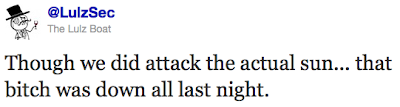
And to end with more lulz, here's my favourite LulzSec tweet of today, which came in the midst of explaining what they had and hadn't actually hacked as the media attributes everything and anything to them:

@LulzSec: Though we did attack the actual sun... that bitch was down all last night.

Monday, February 14, 2011

Free Wordpress themes considered harmful

It used to be that you could tell what was likely to give your computer a virus: if you stayed away from the porn and "free screensavers" then you were pretty much ok. Nowadays, though, with cross-site scripting, it's much harder to gauge which content might be unsafe.

So Why You Should Never Search For Free WordPress Themes in Google or Anywhere Else caught my eye because it's a new example of how free... sometimes isn't. Why bother to exploit people's wordpress blogs, which is illegal in many places, when you can just give them the code and let them install and run it themselves? Mostly it looks like the code found is all about adding spammy SEO-boosting links for dubious properties, but there could definitely be worse elsewhere in those themes: that free theme could be using your blog to install malicious software on your visitors' computers!

Out of the ten sites on the first page of Google, here are the stats:

Safe: 1
Iffy: 1
Avoid: 8
8 out of 10 sites included base64 encoding in their themes. The average WordPress user no doubt knows that Google isn’t the best place to find themes but the stats on these sites show that there are thousands of people downloading them and using them on their websites. Someone who has come to WordPress on the first time is more than likely to type “free WordPress themes” into Google to find a site that gives them what they want. Unfortunately they’re more than likely to end up with spammy links, at best, on their site.

Read the whole article to hear about what might be hiding in that free template you just downloaded. Basically, if you see a bunch of random encoded stuff that you don't understand, you should be awfully wary... Thankfully, the author demonstrates the use of two tools for figuring out if that theme you'd like ot try is safe: Theme Authenticity Checker and Exploit scanner. I guess those are the new antivirus for Wordpress?

Thursday, January 27, 2011

"My account got hacked"

Some bite-sized wisdom from Jeremiah Grossman:

Funny how people, "my account got hacked," rather than "someone hacked into my account", like they think getting hacked is an act of nature.

I had a good laugh, but it's got me wondering... given how frequently attacks occur online, maybe it really does make sense for people to conceptualize attacks as something that just happens as opposed to something more akin to "that guy robbed me." Makes it easier to deal with somehow, or perhaps easier to accept that there will likely be no retribution?

And more disturbingly, does this "act of nature" approach to hacking explain the general public's sometimes apathetic response to routine privacy violations, both online and offline?

Tuesday, December 14, 2010

A brutally honest privacy policy

Dan Tynan has decided to cut through the legalease and confusion inherent in many privacy policies and produced a "real" privacy policy which is open-sourced for anyone to adopt. What results is hilarious and sad at once because it reflects a lot of how "private" data may be used. Here's an excerpt:

"At COMPANY _______ we value your privacy a great deal. Almost as much as we value the ability to take the data you give us and slice, dice, julienne, mash, puree and serve it to our business partners, which may include third-party advertising networks, data brokers, networks of affiliate sites, parent companies, subsidiaries, and other entities, none of which we’ll bother to list here because they can change from week to week and, besides, we know you’re not really paying attention.

We’ll also share all of this information with the government. We’re just suckers for guys with crew cuts carrying subpoenas.

Remember, when you visit our Web site, our Web site is also visiting you. And we’ve brought a dozen or more friends with us, depending on how many ad networks and third-party data services we use. We’re not going to tell which ones, though you could probably figure this out by carefully watching the different URLs that flash across the bottom of your browser as each page loads or when you mouse over various bits. It’s not like you’ve got better things to do.

...

So just to recap: Your information is extremely valuable to us. Our business model would totally collapse without it. No IPO, no stock options; all those 80-hour weeks and bupkis to show for it. So we’ll do our very best to use it in as many potentially profitable ways as we can conjure, over and over, while attempting to convince you there’s nothing to worry about.

Read the rest along with commentary on Dan's blog. He notes that it’s 5,085 words shorter than Facebook’s policy, just for comparison.

Wednesday, November 3, 2010

Security Costs vs Benefits: Should companies deploy SSL to deal with Firesheep?

Yesterday, I talked about why end-users don't care about security and how that actually makes a certain amount of sense for them since the cost of behaving more securely can overwhelm the cost of an actual breach.

However, what I didn't talk about is whether this is true for companies. A single security breach in a single user account maybe doesn't cost a company much, but if breaches get common enough that they start losing users, it could be a problem with a much higher cost.

While users trying to protect themselves from curious folk with firesheep are counseled to use a VPN, website owners can choose to do encryption right from their end using SSL. But it was thought that SSL was computationally costly and even environmentally costly due to the supposed need for extra electricity and machines.

But who's been looking at what those costs actually are? A blog post entitled Overclocking SSL looked at the severity of these costs as they deployed SSL, and made a pretty clear statement:

If there's one point that we want to communicate to the world, it's that SSL/TLS is not computationally expensive any more. Ten years ago it might have been true, but it's just not the case any more. You too can afford to enable HTTPS for your users.

So there you have it: the people who should be protecting users from firesheep attacks are probably the companies who run the websites, since SSL isn't likely to be as costly to them as numerous complaints and support requests would be from their users. The cost equation might not be the same for all organizations, since the cost of certificates and labour can be non-trivial if you don't already have expertise on hand. But sure enough, Google has decided to provide https access by default to all gmail users, so they clearly believe it's worth it.

This leads to an interesting question: Does the burden of security always fall heavily on corporations and large organizations rather than on end-users? Many would argue that this is naive and that users must bear some responsibility, others would argue that only corporations have the resources necessary to make an impact on security. This is a much larger discussion that I expect we'll see occurring over and over again for a very long time.

Tuesday, November 2, 2010

Apathy or sensible risk evaluation: why don't people care about security?

Engineer Gary LosHuertos decided to try Herding Firesheep in New York City: He sat down in a Starbucks, opened up his laptop and started gathering profiles, then sent messages to people whose facebook accounts he could access warning them of the security flaws. Some people closed up and left, but some just ignored his message and went on with their day. Confused, he sent another message, but they just didn't seem to care and continued using their accounts.

This is the most shocking thing about Internet security: not that we are all on a worldwide system held together with duct tape that has appalling security vulnerabilities; not that a freely available tool could collect authentication cookies; and certainly not that there are people unaware of either. What's absolutely incomprehensible is that after someone has been alerted to the danger (from their own account!) that they would casually ignore the warning, and continue about their day.

But is this shocking? To someone who cares about security, maybe. To someone who knows people? Less so.

Cormac Herley has an absolutely great paper entitled "So Long, And No Thanks for the Externalities: The Rational Rejection of Security Advice by Users"

It is often suggested that users are hopelessly lazy and unmotivated on security questions. They chose weak passwords, ignore security warnings, and are oblivious to certificates errors. We argue that users’ rejection of the security advice they receive is entirely rational from an economic perspective. The advice offers to shield them from the direct costs of attacks, but burdens them with far greater indirect costs in the form of effort.

So let's think a little bit about cookies and firesheep. One of the ways to be most safe is to browse using a VPN. For someone who already has one set up, this is pretty much a matter of toggling something on your computer: pretty low difficulty and less trouble than having your accounts hacked. You can see why many geeks think it's ridiculous that people wouldn't just secure their sites: even if you include time setting up the VPN, for many folk that's a task that falls under the heading of "something I meant to do anyhow" and isn't really perceived as costly.

But if you're not a computer-savvy person who has a server online to host a VPN, setting up a VPN can be stupidly costly. Maybe you'd have to replace your router with one that can handle it. Maybe you'd have to pay for hosting. Maybe you'd have to spend hours figuring out how to generate keys, or pay someone else to do that. Maybe just figuring out what you need to do at all is going to take hours. Quickly, the hours required seem worth more than the cost of having some stranger send you messages from your own facebook account, or maybe set your status message to something embarrassing.

Perhaps what we need to raise the costs of a security mishap is a little evil. It's actually easy to craft a firesheep-based attack that would raise the cost high enough to make VPN hunting (or just not using the Starbucks wireless) seem worthwhile to most people: Log into someone's account, delete all their status messages, notes and photos, defriend all their friends. Since there's no easy way to back up your facebook profile, the results would be devastating and partially unrecoverable: worth more than the pain of setting up a VPN or going without FB while in a coffee shop. It might be easier to litigate for theft/unauthorized access than it is to restore that profile, so I don't recommend any security vigilantes start doing this!

So I guess the take-home message here is that while it's worth trying to educate users so they can make smarter decisions, they're not necessarily being delusional or foolish when they just say "meh" and go on with their lives. If we want to make a really huge impact, we need security solutions that are so low-pain that there's no longer any rational reason to reject them.

Friday, October 29, 2010

Apparently Facebook hates privacy so much that they pay lobbyists to stop privacy laws

This maybe shouldn't surprise anyone, but Mashable is reporting that Facebook Lobbied to Kill Social Networking Privacy Act in the USA.

It's one thing to believe that privacy isn't important, or to make mistakes that expose users, but paying people to lobby against privacy legislation that might protect your users seems like a big step further. It makes me concerned as a user of the service.

Incidentally, Facebook has already broken Canadian privacy law (they're not the only ones), and likely the laws of several other countries, so I guess it makes sense that they wouldn't want to run afoul of further laws... but I really wish they'd do this by handling privacy issues better rather than paying people to make sure the laws don't come into effect. Maybe the law was simply ill-conceived (I haven't read it) but this really doesn't sound like the actions of a socially-responsible company. Very disappointing.

Wednesday, October 27, 2010

Quick Hit: Firesheep

By now, probably everyone's already heard of firesheep, the nice user-friendly way to use cookies to do session hijacking. Want to be logged in as someone else on Facebook? No problem.

It's nothing spectacular on a technical level, since it's been easy enough to use other people's cookies for quite some time, but it's a pretty impressive social hacking tool. It's making it clear to a lot of people (and media) that this is a real problem, and that it's an exploit anyone can do now.

I'm actually sort of surprised that I haven't seen this earlier: it used to be a bit of a game in the undergrad lounge to see what one could sniff off the network, with people using some tool whose name I've forgotten to show any images that came up from users surfing on the wireless. Hacking session cookies would have been a fun addition to our childish games -- and I'll bet plenty of college kids are using it for just that. Or for checking out their ex-boyfriends/girlfriends...